Features
Part of Celebrity costumes: the directory, with corrections
Celebrity costumes mistakes that experienced operators still make
Celebrity costumes mistakes sorted into five failure modes, where each one comes from, and how to test a costume before you have to wear it all evening.
A costume that works perfectly on a stage can fail completely at an event. The reason is almost never aesthetic. Stage costumes are built for a set distance, a fixed lighting plan, and a known list of movements.
An evening in a crowd offers none of those. The mistakes below are structural, and each is predictable in a fitting.
What to take away
- A costume is engineered for a specific viewing distance and a specific set of movements. Change either and it stops working.
- The common failures are weight, heat, reach, sightlines, and seating. All five can be tested in an afternoon.
- Most costume disasters were decided at the design stage, when nobody asked how the wearer would sit down, get through a door, or leave.
A costume and an outfit are not the same object
Costume design communicates something about a character to an audience at a distance. Clothing exists to be worn. The two overlap, but their tolerances differ.
A costume can be taped at the back because the audience never goes there, and it can be unbearable for twenty minutes because twenty minutes is all it has to survive.
Move that object to a themed event and both assumptions break. People stand next to you. The evening lasts hours. There is a car, a doorway, a chair, and a queue for the cloakroom. Nothing about the design accounted for any of it.
The five failure modes
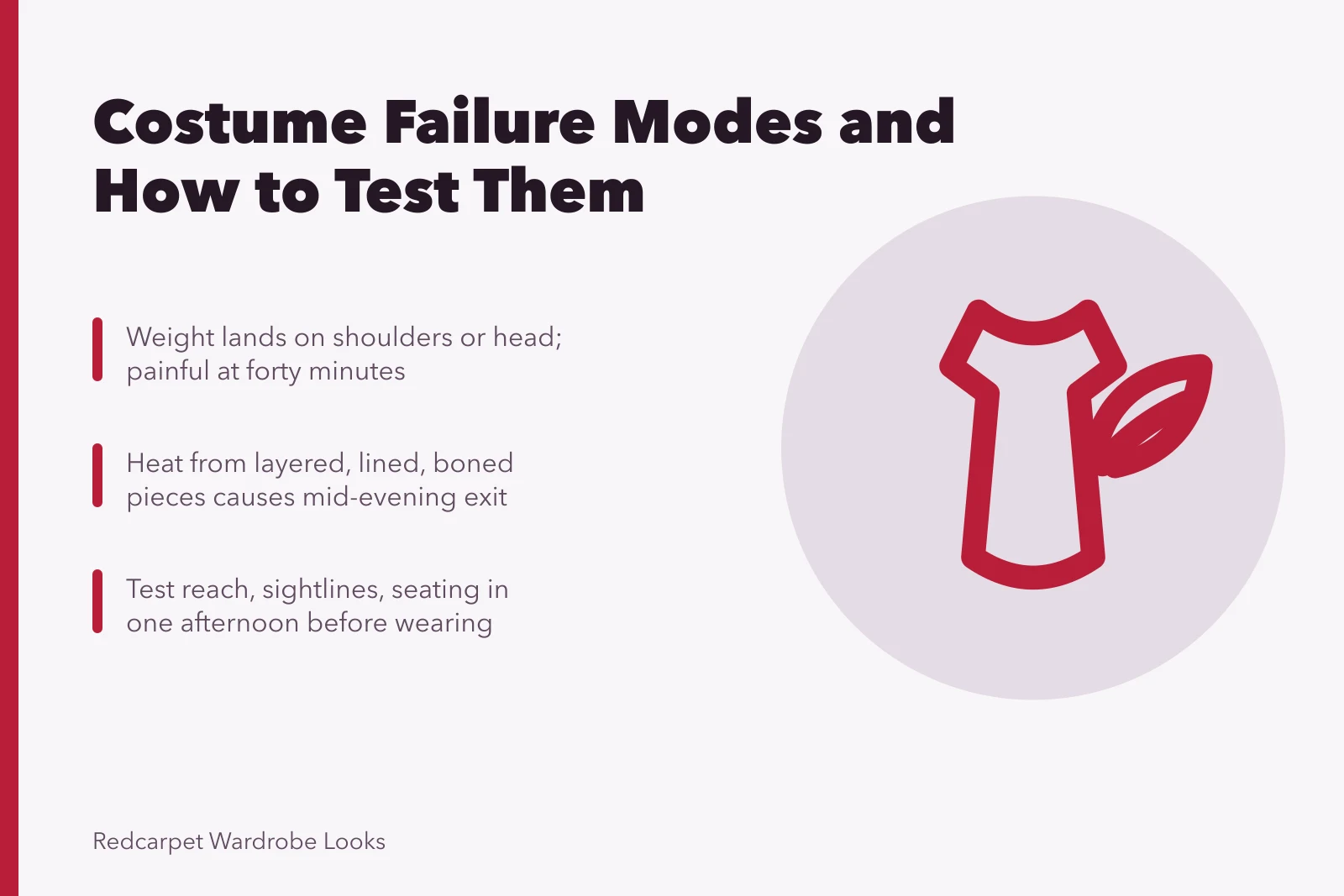
- Weight. Structure, headpieces and applied ornament add up fast, and the load lands on the shoulders or the head. Anything that is comfortable for ten minutes and painful at forty was never tested for the right duration.
- Heat. Layered, lined and boned pieces trap heat, and rooms full of people and lights are warm. This is what causes the exit halfway through, not the design.
- Reach and mobility. Arms up, arms across the body, hands to the face. A silhouette that blocks any of those makes eating, greeting and holding a drink impossible.
- Sightlines. Masks, headpieces and high collars restrict peripheral vision, which matters on stairs and in a crowd more than anywhere else.
- Seating. This is the biggest one. Structured skirts, panniers, tails, wings, hoops and anything rigid at the back either do not fit in a chair or take the chair with them.
Add a sixth for anything with an internal frame: attachment. A piece that hangs from a hidden harness works until the harness shifts, and it shifts when you move differently from the way you moved in the fitting.
Six Costume Failure Modes
- Weightload on shoulders or head
- Heatlayered, lined, boned pieces trap heat
- Reacharms up, across, hands to face
- Sightlinesmasks, headpieces, high collars
- Seatingstructured skirts, tails, wings, hoops
- Attachmenthidden harness shifts when you move
Where the mistakes actually come from
Where the mistakes come from
- The piece was designed from a picture rather than for an evening. A single strong image is a legitimate goal, but then it should be photographed and changed into something wearable, not worn for six hours.
- It was built on a stand and never fitted on the body in motion. A dress form does not sit down, and it does not raise its arms.
- The understructure was an afterthought. Shape in a heavily structured garment comes from what is underneath it, which is why boned foundations exist and why substituting a lighter one collapses the whole silhouette.
- It was made to a sample size and adjusted late. Late alterations to a structured piece move the balance points, and the piece stops hanging the way it was drawn.
- Nobody rehearsed the transitions. Getting in, getting out, getting up, and getting through. Those four are where costumes fail in public.
The judgment mistake
One category is not mechanical: dressing as a culture, religion, or real community instead of a character goes wrong no matter how well the piece is made. No amount of workroom skill repairs it.
The distinction that holds up is between playing a character from a story and wearing somebody's living identity as a costume.
The workable test is simple: could you explain the reference to a person from that tradition and expect them to recognize it as respect rather than as a joke? If that question is uncomfortable, the answer is already in. This is a design decision like any other, and it belongs at the sketch stage rather than in an apology afterwards.
Testing a costume before you wear it
Testing a costume
| Test | How | What it catches |
|---|---|---|
| Forty minute wear | Put it on and keep it on, in a warm room | Weight, heat, pressure points, anything that pinches |
| Chair test | Sit on a hard chair with a back, then stand up unaided | Structured skirts, tails, back-mounted pieces |
| Doorway test | Through a standard door, and a car door if there is one | Width, headpiece height, protruding elements |
| Reach test | Hands to face, arms overhead, arm across the body | Eating, drinking, greeting, adjusting anything |
| Stairs test | A full flight, in the shoes, looking ahead | Hem, sightlines, balance with a headpiece |
| Bathroom test | Do it | The single most skipped test and the most consequential |
Anything that fails gets fixed before the event or the design changes. There is no third option, and pretending otherwise is how people end up standing all night.
Costume Pre-Event Test Protocol
- Forty minute wearin a warm room
- Chair testsit on hard chair, stand unaided
- Doorway teststandard door, then car door
- Reach testhands to face, arms overhead
- Stairs testfull flight, in the shoes
- Bathroom testdo it, most skipped
What good practice looks like
Plan the evening around the piece, not the reverse. Decide ahead which parts come off and when, so the headpiece has a place after photos.
Bring tools for the repair you can predict: the same closure fails twice. Have a second person who knows how the piece works, since most structured costumes cannot be put on or taken off alone.
The same testing discipline used for ceremony outfits applies here, only harder, and the construction choices behind it are set out under costume styles. The lighter version of the same failures shows up under common dressing mistakes.
Common questions
Why do so many themed looks appear only in photographs and then vanish?
Because they were changed out of. A piece built for one image is often removed immediately afterwards, which is a sensible plan rather than a failure.
Can a costume be made comfortable without losing the shape?
Usually yes, by moving the load. Weight on the shoulders can go to the hips, rigid frames can be hinged, and a headpiece can be built lighter. It costs workroom time, which is why it is skipped.
How early should a costume be finished?
Early enough to wear it for an hour and change what fails. The last fitting should not be the first time you sit down in it.
Where does the line between costume and clothing sit?
Roughly where the wearer stops being able to do ordinary things. Beyond that you have a piece for photographs, which is fine as long as everyone involved knows it. The broader subject sits under costume dressing and the people who build it under design and styling work.