Industry
Part of Celebrity costumes: the directory, with corrections
Four ways a celebrity costume holds its shape, from workroom to fitting
Celebrity costumes styles as construction: the sequence in a workroom, four ways of holding a shape, and what to bring a maker before commissioning work.
A costume style is a set of construction decisions made in a workroom weeks earlier.
How the shape is held, what carries the weight, and whether the surface is woven or applied: those choices decide what the finished piece looks like more than the sketch does. This happens between the idea and the evening.
What to take away
- Every recognizable costume style corresponds to a way of building. Learn the four building methods and the styles stop looking arbitrary.
- The mock-up stage is where a design becomes possible or impossible, and skipping it is the most expensive saving in the process.
- If you are commissioning, what the maker needs from you is a date, a set of movements, and a budget, in that order.
The sequence in a workroom
A build runs in a fixed order because each step depends on the one before it.
Workroom build sequence
- Briefread, distance, duration, room
- Researchcollections, catalogs, published images
- Drawingdecide how shape is held
- Patterndrafted or draped flat pieces
- Mock-upcheap cloth, fitted on body
- Materialschosen against the mock-up
- Build, fittings, finishing, surface work
The mock-up is the step people try to cut. It is also the only point where a bad idea is cheap to abandon.
Draping directly on a dress form is faster. That is why many workrooms combine the two methods. But a form does not sit down or raise its arms, so a fitting on the actual body still has to happen.
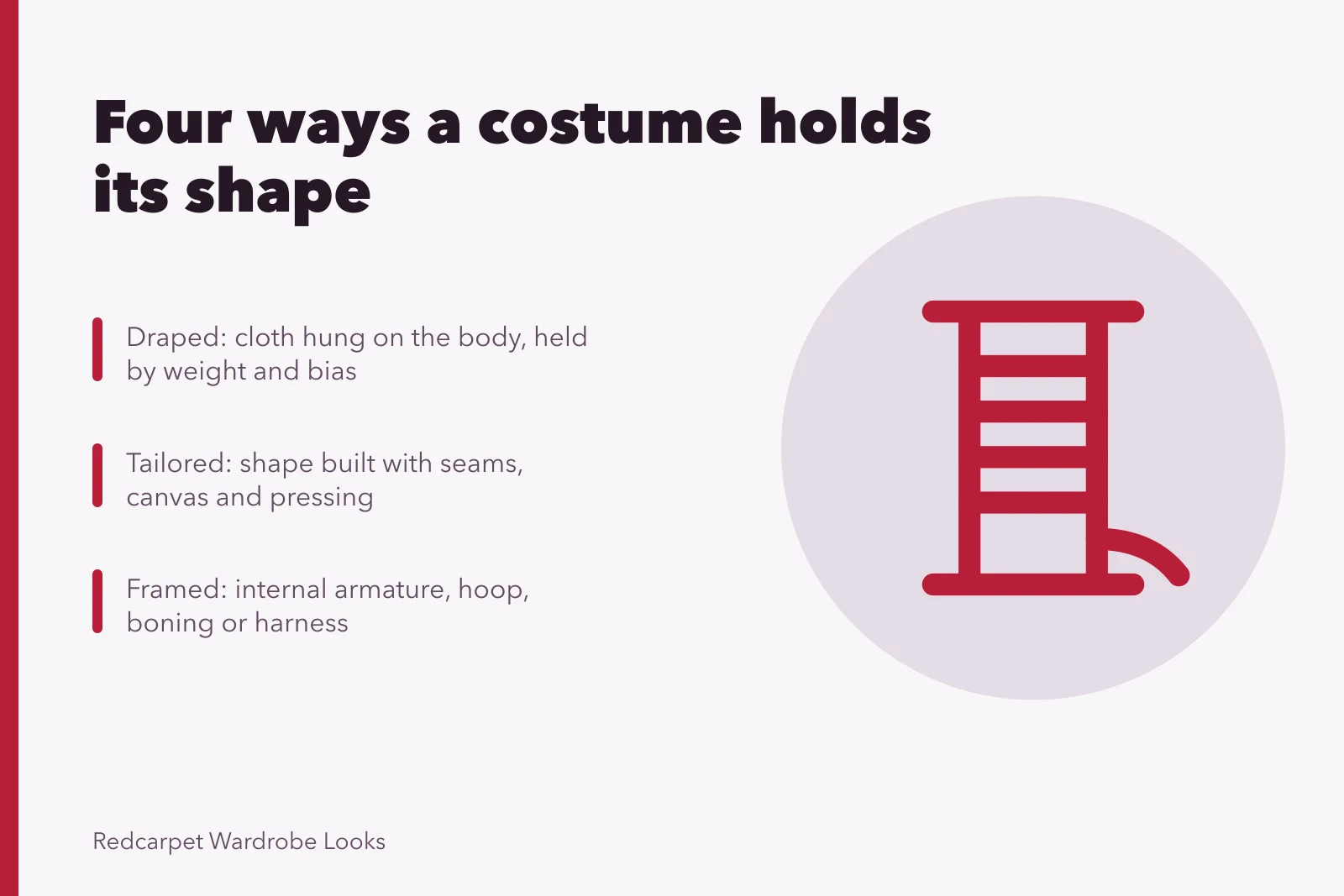
Four ways of holding a shape
How the shape is made
- Draped
- Cloth hung and manipulated on the body, held by weight and bias
- Tailored
- Shape built with seams, canvas and pressing
- Framed
- An internal armature, hoop, boning or harness carries the form
- Applied
- Surface work laid onto a simple base: beading, feathers, printing, molding
What it does well
- Draped
- Movement, softness, anything that has to flow
- Tailored
- Precision, structure that still moves with the body
- Framed
- Volume the body cannot produce on its own
- Applied
- Impact at distance, and speed of visual reading
What it costs
- Draped
- Needs a lot of fabric and skilled hands; unforgiving of cheap cloth
- Tailored
- Hours of labor; the shoulders are the hard part
- Framed
- Weight, heat, and problems with chairs and doorways
- Applied
- Heavy, fragile, and hard to alter once applied
Most real pieces mix two. A framed skirt under a draped bodice is common; so is a tailored base carrying applied surface work. Knowing which combination you are looking at tells you what the piece will and will not tolerate on the night, which is the whole subject of costume mistakes.
Four ways to hold a shape
Draped
- How made
- Cloth hung on body
- Does well
- Movement, softness, flow
- Costs
- Fabric, skilled hands
Tailored
- How made
- Seams, canvas, pressing
- Does well
- Precision, structure that moves
- Costs
- Hours of labor
Framed
- How made
- Internal armature, hoop, boning
- Does well
- Volume body cannot produce
- Costs
- Weight, heat, doorways
Applied
- How made
- Surface work on simple base
- Does well
- Impact at distance
- Costs
- Heavy, fragile, hard to alter
Materials decide more than color
- Weight per length is the first number a maker thinks about. It determines whether a shape hangs or collapses.
- Drape and recovery. Some cloth falls into soft folds and springs back; some creases and stays creased. A long seated event needs the second kind to be avoided.
- Grain direction. Cut on the bias, woven cloth stretches diagonally and clings, which is a design tool and a fitting problem at the same time.
- Surface behavior under light. Matte cloth holds its color, satin and sequin throw the light back, and a mixed surface reads as texture in a photograph.
- Structural fabrics you never seecanvas, horsehair, net and interlining. These are what make a tailored or framed piece keep its shape, and substituting them lighter is the usual reason a finished piece looks soft.
If a maker asks what the piece has to survive before asking what it should look like, that is a good sign. The answer changes the material list completely.
Material questions before choosing
- Weight per lengthhangs or collapses
- Drape and recoveryfolds or creases
- Grain directionbias stretches and clings
- Surface under lightmatte, satin, sequin
- Structural fabricscanvas, horsehair, net, interlining
Commissioning without wasting anyone's time
Bring these to a first conversation and the quote will be realistic.
Bring these to a first conversation
- The date, and fitting deadline
- List of things you must do in it
- Three reference images plus a sentence each
- Your budget as a range, stated first
- Whether it survives one evening or several
Expect a maker to push back on at least one thing. Pushback at the drawing stage is cheap; the same conversation after the cloth is cut is not. What a professional stylist or designer contributes here is mostly this: knowing which requests are expensive and saying so early.
Adapting instead of building
Most people do not need a build. Adapting an existing garment covers a large share of themed dressing, and the same principles apply.
Adapting an existing garment
- Start from a base that fits at shoulders
- Add structure rather than replacing it
- Keep applied work off seat and inner arms
- Put strongest element at chest height
- Keep the piece honest about its period
Start with a base that fits at the shoulders and through the body, since those are the hardest areas to alter. Add structure rather than replacing it: a stiffened underskirt, a collar, a sleeve.
Keep applied work off the seat and off the inside of the arms, where it will be crushed or catch. Put the strongest element at chest height, where a camera and a person at conversational distance both look.
Working this way also keeps the piece honest about its period. A shape copied loosely from a decade reads as that decade, which is why the material under style by decade is a better starting point than a picture of one finished outfit.
Common questions
Why do makers insist on a mock-up?
Because a flat pattern is a prediction. The mock-up is the test, and it is made in cheap cloth precisely so it can be cut up and changed.
How long does a structured piece take?
Longer than the calendar usually allows, because fittings have to be spaced apart. Ask for the fitting dates rather than the delivery date; those tell you whether the schedule is real.
Can a rented or bought piece be altered heavily?
Rented, rarely, since it must go back unchanged. Bought, yes, within limits: shoulders and heavily structured bodices resist alteration, and applied surface work over a seam usually blocks it entirely.
Which method should I choose for a first attempt?
Draped or applied over an existing base. Both give a strong result without the hours that tailoring and framing demand, and both fail gently. The wider context sits under costume dressing.