Reviews
Part of Where the money sits: an engagement ring purchase, broken down
How to choose engagement rings as a shared decision, not a surprise
How to choose engagement rings as a shared decision: the conversation to have first, the constraints that eliminate most designs, and the terms to get in writing.
Choosing a ring is a sequence of decisions in which the early ones close off the late ones. Done in the wrong order it becomes an argument about a number. Done in the right order the number arrives last, as a consequence of choices that were made for reasons anyone can explain afterward.
What to take away
- Have the money conversation before the shopping conversation. A range plus a priority order is the only brief a seller can work with honestly.
- Two or three physical constraints eliminate most of the catalog before taste is involved. Start there and the choice gets small quickly.
- Everything you will rely on later, from returns to resizing to insurance, is a written term you have to ask for at the counter.
Step one: the conversation before the shop
Six questions, answered together, in one sitting.
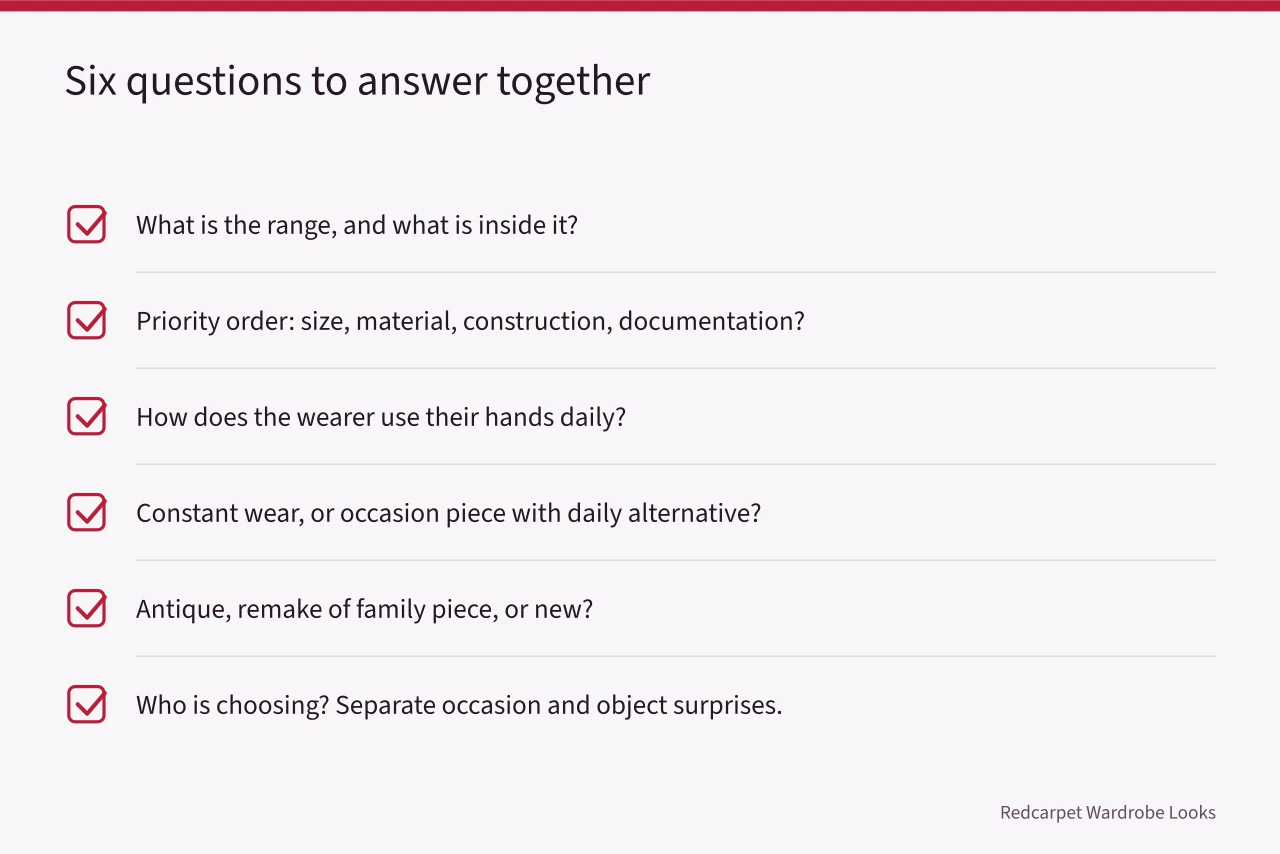
- What is the range, and what is inside it? Sizing, the accompanying band, insurance and the first service are real costs and usually forgotten.
- What is the priority order between size, material, construction and documentation? You are choosing which of the four gets the money.
- How does the wearer use their hands, daily? This settles more of the design than any preference will.
- Is this a ring to wear constantly, or an occasion piece with a plainer daily alternative? Two answers, two very different buys.
- Does anyone involved want an antique, a remake of a family piece, or something new? Each has a different process and a different timescale.
- Who is choosing? A surprise about the occasion and a surprise about the object can be separated, and often should be.
Write the answers down. It is the document that keeps a shop conversation on your terms rather than the seller's.
Step two: apply the hard constraints
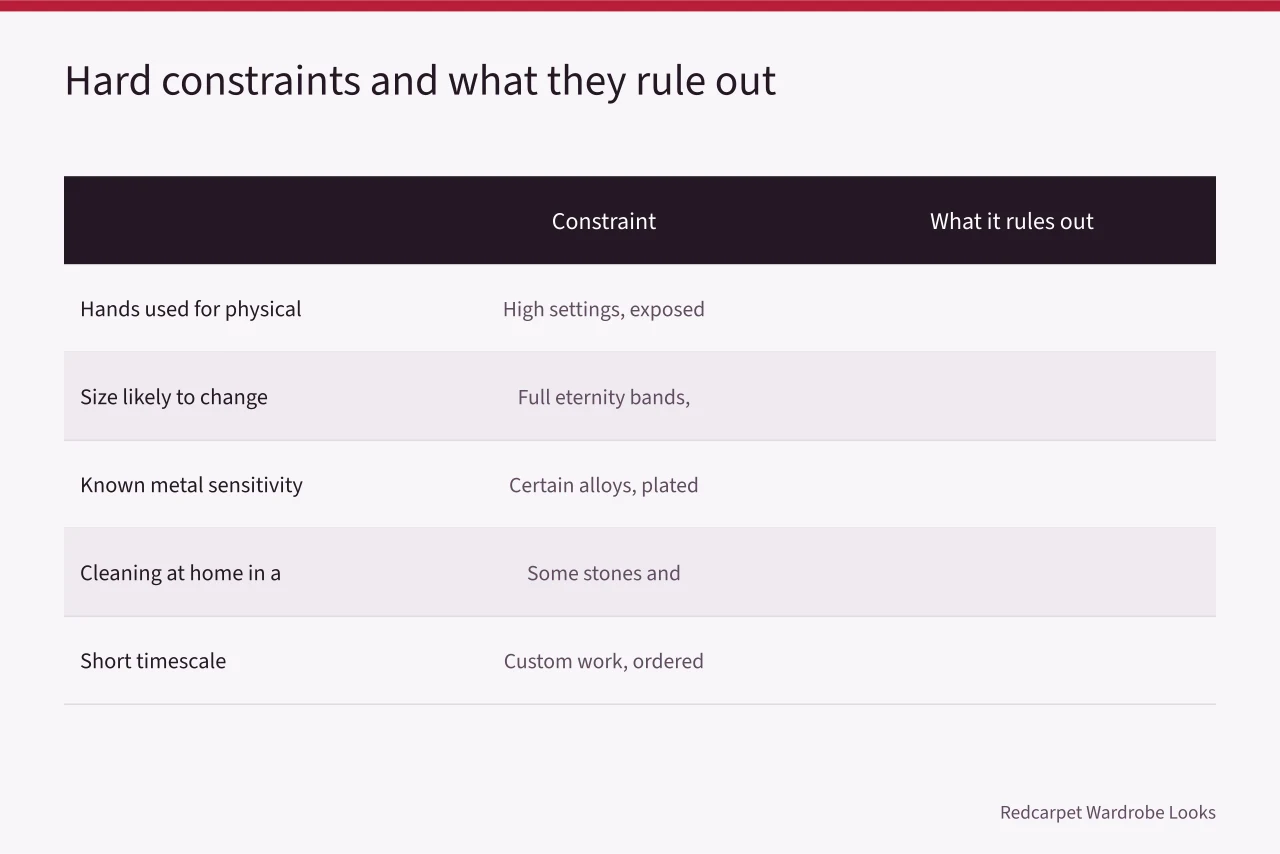
| Constraint | What it rules out |
|---|---|
| Hands used for physical work | High settings, exposed corners, fine bands, anything set into the palm side |
| Size likely to change | Full eternity bands, tension settings, deeply engraved shanks |
| A known metal sensitivity | Certain alloys, and any plated finish that will wear through to what is underneath |
| Cleaning at home in a machine | Some stones and treatments do not tolerate it, so ask before buying |
| A short timescale | Custom work, and anything that has to be ordered and then sized |
The mechanics behind each of these, and what each setting is doing for the stone, are laid out in what a setting holds. Applying the constraints first is not a compromise; it is the difference between a ring that gets worn and one that lives in a drawer.
Step three: decide the stone question
There are three separable decisions and people routinely merge them.
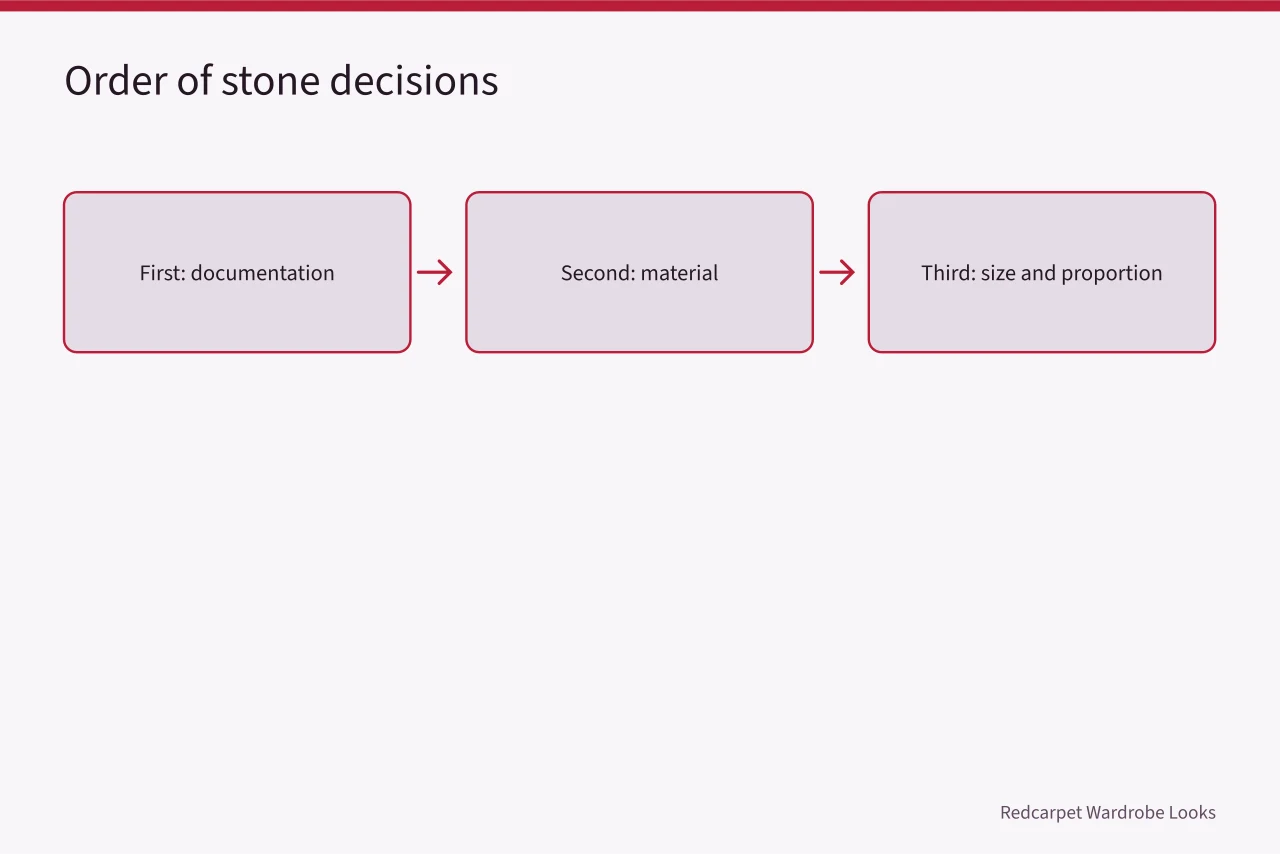
- What material. A mined stone, a laboratory-grown one of the same material, or a different material entirely are three different products, and each must be described as what it is. In the United States the FTC's guidance for jewelry sellers covers how that description is supposed to be made; elsewhere the equivalent authority sets the wording.
- What size and proportion. Weight is measured in carats, which is a mass rather than a size, so two stones of equal weight can look noticeably different depending on how they are cut.
- What documentation. Whether an independent laboratory report exists, and from which laboratory.
Decide documentation first, material second and size last. Reversing that order is how people end up with a large stone and no way to establish what it is.
Step four: get the terms in writing
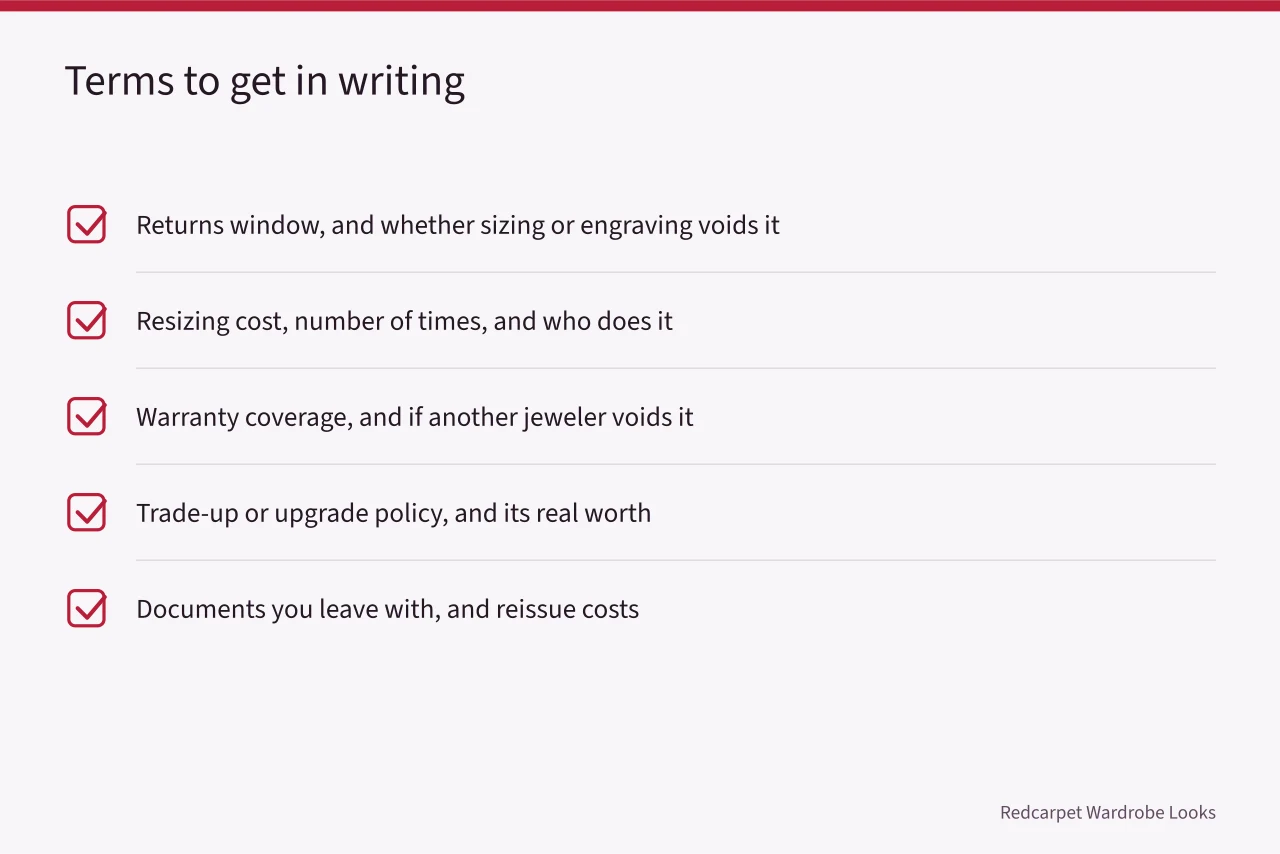
- The returns window, and whether it survives sizing or engraving.
- What resizing costs, how many times it can be done, and whether the seller does it.
- What the warranty covers, and whether it is void if another jeweler touches the ring.
- Whether a trade-up or upgrade policy exists, and what it is actually worth in practice.
- What documents you leave with, and what it costs to have any of them reissued.
Then insure it from the day you collect it. The gap between collection and cover is a common and completely avoidable loss, and it is on the list under the mistakes that cost money.
Step five: buy from a channel you understand
Each channel charges you something different. A traditional shop bundles service and returns into the price. An online seller strips both out and prices accordingly. A private or auction purchase removes the safety net entirely and rewards the buyer who inspects. An independent maker sells you hours rather than stock.
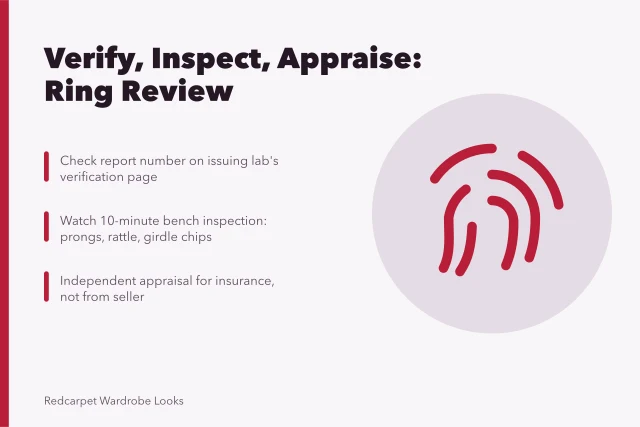
Whichever channel, run the same inspection before money changes hands, in the order set out under inspecting a ring. Where the value actually sits, and how to get more of it for less, is the subject of spending well, and the general principles of reading metal and stones are in the pillar on pieces.
Common questions
How much should we spend?
Nobody can answer that for you, and any published rule about a number of months of income is marketing rather than guidance. Set a range you are both comfortable with and spend it in the priority order you agreed.
Is buying online reasonable?
Yes, with two conditions: an independent report you verify yourself, and a returns window long enough for a jeweler to inspect the ring in the hand. Without both, the saving is being paid for with risk.
What if we disagree about the design?
Separate the disagreement into constraint and preference. Constraints are facts about hands, work and size. Preferences come after. Most disagreements dissolve once the constraint list has removed the impossible options.
Should the wearer be present?
For sizing and comfort, ideally yes. If the choice is meant to be a surprise, take a ring they already wear on the correct finger to a jeweler for a size, and keep the returns window long.