
Guides
How Red Carpet Fashion Is Made for the Camera
Red carpet fashion is shaped by the press line, flash, borrowed garments, fittings, alterations, and a fixed event schedule.
Red carpet fashion is made for the photograph; a carpet is not a party with photographers at it. It is a photo assignment with a party at the end. Everything about how the clothes are made, chosen, fitted and finished follows from that, and almost nothing about it follows from what would be comfortable or flattering in a room.
Seen as a production problem, the odd decisions make sense. A garment that looks heavy in a shop window is built to survive a wind tunnel of camera flashes.
A neckline that seems severe in person is set for a lens two meters away and slightly below. The work is designed for the photograph, and the photograph is the product.
What to take away
- The carpet is a controlled press line with a fixed running order, and the clothes are built for its specific optics.
- Almost nothing worn on one is bought. It is lent, fitted, and returned, which changes every decision made about it.
- What ruins a look on camera is usually construction and light, not taste.
What the line actually is
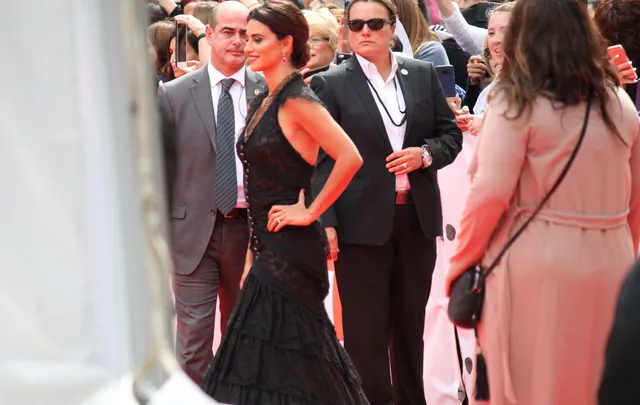
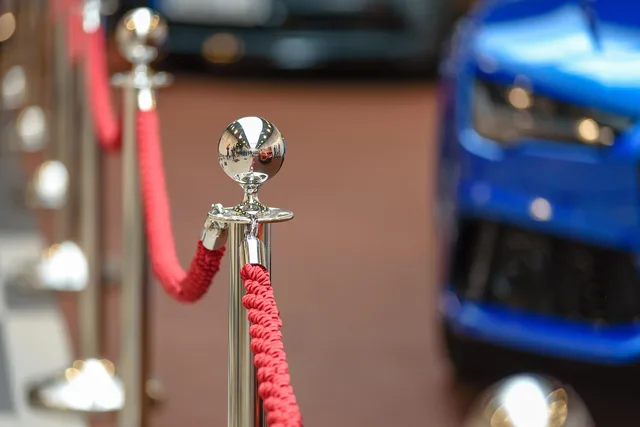
The setup is a lane, a barrier, a bank of photographers at one end, and interview positions along the way. Behind the subjects sits a step and repeat backdrop, so no photograph runs without the event's name in it — the Academy Awards, the Met Gala, the Golden Globes, the Grammy Awards, the Cannes Film Festival.
The photographers at the end of that lane mostly work for photo and wire agencies — Getty Images, the Associated Press, Reuters — and their frames are what most outlets publish the next morning.
The lane has a running order, a schedule, and people whose job is to keep it moving.
That structure creates the constraints the clothes are answering:
- You stand still, in one spot, for a short and fixed time.A garment has to look finished in a static pose rather than in motion.
- You are photographed from slightly below.Lenses sit at chest height and shoot up. Hems, shoe height and the line from waist to floor read very differently from that angle than they do in a mirror.
- You turn on the spot, repeatedly.Anything that has to be held, adjusted or arranged between turns will be caught mid-adjustment by somebody.
- You then have to walk, sit, and get through a doorway.A silhouette that only works standing is a garment that will produce one good frame and a difficult evening.
What the light does
The line is lit by flash, and flash is not like any light a garment was designed in. It is close to the lens, it is very brief, and it is far brighter than the room.
Three consequences cause most visible damage.
Bright direct flash flattens texture, so subtle fabric surface interest disappears and leaves a shape with no detail. Reflective items return light straight down the lens, so heavy beading or sequins read as a bright patch, not ornament.
Pale, thin fabrics act unpredictably when a strong short burst passes through. That is why fittings are done under light, not by eye alone.
The underlying behavior is ordinary flash photography, and it is why a fitting room verdict is not a prediction. Anyone working seriously tests the garment under a light source that behaves like the one at the event, photographs it, and looks at the photograph rather than the person.
Color is the other half of the problem. A shade chosen in daylight, in a showroom, under warm light, will not necessarily be the same shade on the line, and two fabrics that matched in the showroom can stop matching under flash. This is why a look is signed off from a test image and not from a swatch.
How the production schedule shapes the look
The interesting part of the craft is not the garment. It is that the garment has to exist, fit one specific body, and be finished by a fixed hour on a fixed day, with no possibility of moving the date.
Stylists run that calendar — Law Roach, best known for his work with Zendaya, is the obvious example — and a large part of the job is project management: chasing shipments, booking fittings, and keeping a fallback option alive.
The sequence, roughly: a request goes out well before the event. Pieces are offered and shortlisted, and one or more are shipped in. Fittings happen against the calendar, and alterations follow, sometimes to the last afternoon.
Support garments — often shapewear such as Spanx, sometimes a custom-built piece — are built or sourced to hold the shape. Shoes are decided, because the hem cannot be finished without them. Then the piece is finished, pressed, and delivered on the day.
Two things about that sequence are worth understanding.
The first is that alterations do most of the work. A garment lent from a showroom was made to a sample measurement, not to a person, and turning it into something that looks made for someone is hours of skilled labor. That labor is invisible in every photograph and it is the difference in every photograph.
The second is that the schedule has no slack. A late shipment, a damaged piece, a fitting that goes wrong or a change of mind on the day all land in the same narrow window. That is why anyone doing this professionally works with a second option in the room.
Everything is borrowed
Almost nothing on a carpet was purchased. Pieces are lent by the house or archive — the collections run by Chanel, Dior, Valentino, Armani and Gucci among them — expected back, and somebody answers for their condition.
That single arrangement explains much of the visible behavior: a piece arrives by courier and is photographed before it leaves, and a dresser stays close by. Food and drink are handled carefully, and the piece is collected afterwards rather than kept.
It also explains the coverage. A loan is granted so that the garment is seen and credited, which is why publicists and house press offices negotiate the credit line and why that line in an article is part of the arrangement rather than a neutral observation. When you read that someone "chose" something, the sentence is sometimes describing a preference and sometimes describing an agreement, and the article rarely distinguishes them.
Jewelry goes further still. High-value pieces from houses such as Cartier, Bulgari and Tiffany travel with security, are signed in and out, and are returned the same night. None of it belongs to the person wearing it.
What actually goes wrong
Not taste. The recurring failures are mechanical, and every one of them is a construction or planning problem.
| Failure | What causes it | When it should have been caught |
|---|---|---|
| Fabric creasing across the lap | Sitting in a car or at the event in a cloth that holds a fold | At the fitting, by sitting down in it |
| A hem that catches underfoot | Length set without the actual shoes, or a floor with more friction than expected | At the fitting, wearing the shoes, walking |
| A neckline or strap that will not stay | Weight of the garment unsupported by anything structural | When the support garment was chosen, or skipped |
| Visible adjustment in every frame | Something that must be held or arranged by hand | When the piece was selected |
| Marks appearing during the evening | Makeup transfer, damp, or friction at the seams | At preparation, with barriers and a repair kit on hand |
| A microphone with nowhere to go | No plan for where a transmitter and cable sit in a fitted garment | At the fitting, with the sound team's requirements known |
The pattern is that the fixable ones are fixed at a fitting by somebody doing the boring version of the work: sitting down, walking, turning, and looking at a photograph of the result.
Reading coverage without a name attached
Learn the craft from photographs without judging anyone in them; look at the seams rather than the person. Ask where the garment is supported and by what, and check whether the hem stays at one height all around.
That constant hem height shows whether the garment was set on that body. Notice where light returns and where it is absorbed, and whether the shape holds across several frames or only the published one.
That reading is repeatable, it applies to your own clothes, and it does not require an opinion about a stranger.
Common questions
Why do so many looks appear too formal for the event?
Because they are built for a lens rather than a room. Detail that reads as heavy in person is often the amount of structure required to hold a shape through a series of flash exposures without collapsing.
Are the clothes really returned?
Usually, yes. The default arrangement is a loan with conditions attached, and the piece goes back to an archive that will lend it again. Purchase and gifting happen, but they are the exception rather than the pattern.
Does any of this transfer to an ordinary event?
The parts that cost nothing do. Set a hem in the shoes you will wear. Sit down in the garment before the day. Decide what holds the shape. Photograph yourself under a flash and look at the picture rather than the mirror. That is most of the professional advantage, and none of it is expensive.
Why is the same garment described differently in different articles?
Because credits come from whoever supplied the information, and outlets receive it from different sources at different times. Where an article states a detail with no attribution, treat it as a claim rather than a fact.
In this guide
- 5 details of red-carpet fashion ideas people missRed-carpet fashion ideas 2027 start as a shortlist: what an archive can give you, reissue versus quote, and where the credit tends to go missing.
- What a red-carpet fashion house's carpet work actually consists ofBest red-carpet fashion brands 2027 rethought: what a credit line counts, what a house's carpet work consists of, and criteria you can apply yourself.
- Why red-carpet looks are lent, not sold, and the four alterations to makeAffordable red-carpet fashion: why houses lend rather than sell, which parts of a formal look are labor, and the four alterations that do most of the work.
- Red carpet fashion mistakes: when they beginRed carpet fashion mistakes often start at the swatch, fitting or loan stage. Learn which checks catch hem, fabric, movement and event-day problems in time.
- A red-carpet fashion checklist for fabric, fit, and movementA red-carpet fashion checklist for fabric, construction, fit and movement, plus the terms to settle before paying and what to bring to the tailor.
- Red-carpet fashion examples that explain the look clearly: the parts worth your timeTwenty red-carpet fashion examples in one table, how to read it, which shapes quote a period, and how to use the twenty for an event of your own.