Industry
Part of Style by decade: what the experienced already know
Best style by decade brands 2027: guide and criteria, in plain terms
The best style by decade brands 2027 guide names the fashion houses that defined each era, from Chanel to Balenciaga, and how to read their signature looks.
The best style by decade brands come down to a handful of names that solved a problem everyone else then copied. The red carpet still runs on those solutions.
This guide ranks the houses that defined each decade from the 1920s to the 2000s, states the criteria behind the ranking, and shows how a stylist reads a period reference without turning a client into a costume.
What to take away
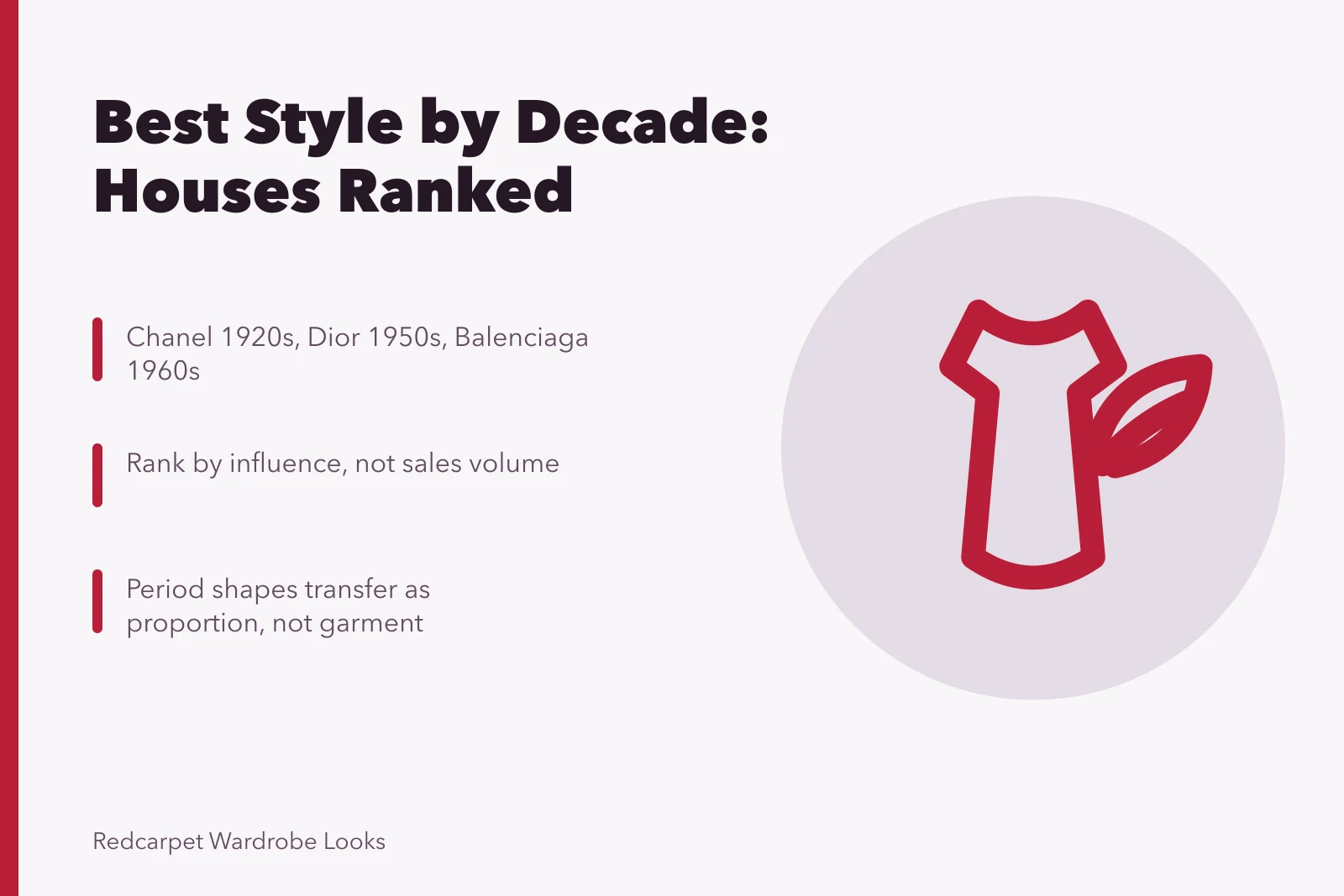
- Rank by influence, not salesa house earns its place by changing what other designers cut, not by volume sold.
- One house per decade carries the defining silhouette. Chanel for the 1920s, Dior for the 1950s, Balenciaga for the 1960s.
- A period reference transfers as proportion, not as a garment. Waist height, shoulder width and hem drop are what move.
- Most period shapes need a foundation layer the photograph does not show. That is why a literal copy reads as fancy dress.
- Museum records beat roundups. The Victoria and Albert Museum's fashion holdings are searchable by material and date.
- Archive prices are typical ranges, not quotesTom Ford era Gucci suits resell around $600 to $2,500, and 1980s Mugler jackets around $400 to $1,500.
The criteria behind the ranking
Four tests decide the order. First, did the house change how other designers cut? Second, does the silhouette still appear on a red carpet today? Third, is the work documented in public collections a reader can check? Fourth, does the house own a technique, a fabric or a proportion rather than a single famous dress.
Four tests for the ranking
- Did the house change how others cut?
- Does the silhouette appear on a red carpet today?
- Is the work documented in public collections?
- Does the house own a technique, fabric or proportion?
Sales figures do not enter. A house can sell enormously and change nothing, and a house can sell little and reset every hemline in Paris.
The ranked list, decade by decade
| Decade | Defining house | What it solved | Still worn because |
|---|---|---|---|
| 1920s | Chanel | Jersey daywear, dropped waist, no corset; the little black dress printed in Vogue in 1926 | The relaxed column underlies modern minimalism |
| 1930s | Madeleine Vionnet | Bias cut on the true cross, often from a single length of silk; house closed in 1939 | Bias gowns remain the default red-carpet shape |
| 1940s | Cristobal Balenciaga | Sculpted shoulder under fabric rationing; Paris house opened in 1937 | The strong shoulder returns every few seasons |
| 1950s | Christian Dior | The New Look waist and full skirt, shown February 12, 1947 | The hourglass is the most copied evening silhouette |
| 1960s | Balenciaga, then Courreges | Shift dress, space-age white, short hem; Courreges showed Moon Girl in 1964 | The shift is the simplest formal dress to wear |
| 1970s | Halston | Single-seam jersey, American ease, sold at Bergdorf Goodman | Jersey columns dominate modern awards dressing |
| 1980s | Thierry Mugler | Power shoulder, corseted waist; label founded in 1974 | The exaggerated shoulder is the current revival |
| 1990s | Tom Ford at Gucci | Sharp tailoring, minimal sex appeal; velvet hipster trousers in 1995 | The clean suit is the default red-carpet tuxedo |
| 2000s | Nicolas Ghesquiere at Balenciaga | Technical fabric, futuristic tailoring; Motorcycle bag in 2001 | Archive pieces trade at auction as collectibles |
Each row is one decade, ranked on those four tests. The notes below give each house one or two facts a stylist can use.
Defining houses by decade
- 1920sChanel jersey daywear, dropped waist, little black dress
- 1930sVionnet bias cut on the true cross
- 1940sBalenciaga sculpted shoulder under rationing
- 1950sDior New Look waist and full skirt
- 1960sBalenciaga, then Courreges shift dress, space-age white
- 1970sHalston single-seam jersey, American ease
- 1980sMugler power shoulder, corseted waist
- 1990sTom Ford at Gucci sharp tailoring, minimal sex appeal
Gabrielle Chanel put jersey into daywear and dropped the waist. Vogue printed her little black dress in 1926, and Chanel No. 5 had arrived in 1921. No corset, a relaxed column, and a shape that still underlies modern minimalism.
Madeleine Vionnet cut on the true bias, sometimes from a single length of silk, so the gown skimmed the body instead of gripping it. Bias gowns remain the default red-carpet shape, and her house closed in 1939.
Cristobal Balenciaga opened his Paris house in 1937 and built a shoulder that held its line while fabric was rationed. The strong shoulder he cut returns every few seasons, most recently in tailoring.
Christian Dior showed the New Look on February 12, 1947, with a nipped waist and a full calf-length skirt. The hourglass is the most copied evening silhouette, and the underpinnings that hold it are the part clients forget.
Balenciaga's shift came first. Andre Courreges answered in 1964 with the white Moon Girl collection, short hems and flat boots. The shift is the simplest formal dress to wear, and Balenciaga closed his house in 1968.
Halston cut jersey in a single seam and sold it at Bergdorf Goodman, dressing American women with an ease that European tailoring had not offered. Vintage Halston gowns typically resell for $300 to $1,200, depending on condition and era.
Thierry Mugler founded his label in 1974, pushed the 1980 shoulder past the natural line, then pulled the waist in. The exaggerated shoulder is the current revival, and Mugler archive jackets typically resell from $400 to $1,500.
Tom Ford took charge of Gucci womenswear in 1990 and showed velvet hipster trousers with a loose silk shirt in 1995. The clean suit is the default red-carpet tuxedo, and Ford era pieces typically resell from $600 to $2,500.
Nicolas Ghesquiere arrived at Balenciaga in 1997 and launched the Motorcycle bag in 2001, later renamed the City. Technical fabric and futuristic tailoring made his archive pieces auction collectibles, and early City bags typically resell for $700 to $1,600.
Two names sit outside the decades because they span all of them. Azzedine Alaia cut for the body across five decades, and Yves Saint Laurent gave ready-to-wear its tailoring vocabulary in 1966 with Le Smoking.
Reading a decade before you dress someone
A decade is a set of measurements, not a mood board. Where the waist sits, how wide the shoulder reads, where the hem falls against the shoe, and how much fabric moves when the wearer walks.
Hem and waist by decade
Chanel 1920s
- Waist
- Natural
- Hem
- Day dress
- Underpinnings
- None
Dior 1950s
- Waist
- Corselet-held
- Hem
- Mid-calf
- Underpinnings
- Corselet, petticoat
Courreges 1964
- Waist
- Shift
- Hem
- Knee
- Underpinnings
- None
Take the 1950s. The Fashion Institute of Technology's timeline entry for the 1950s shows the Dior waist and the full skirt, and its footnotes lead to the primary garments. What the photograph does not show is the corselet and the petticoat holding the shape. Skip those and the dress collapses into a sack.
Chanel's 1920s day dresses fall at the natural waist. Dior's 1950s skirts drop to mid-calf. Courreges raised the hem to the knee in 1964.
That gap is the single most common reason a careful reference reads as costume. The reference, homage and copy distinction turns on whether the underpinnings travel with the look.
Inside a museum record
A catalog record mixes statements of different reliability, and they do not deserve equal weight.
Reliability of catalog fields
- 1Accession facts strongest field
- 2Dating usually a range
- 3Attribution certain, probable or traditional
- 4Provenance least complete, most quoted
When a record and a magazine article disagree, the record wins. When two records disagree, cite both.
Where a brand ranking goes wrong
Survivorship is the trap. Collections hold what someone thought worth keeping, which skews toward expensive clothing and toward events. Ordinary dress survives in photographs, not in accessioned objects. Attribution is uneven too: an unlabeled dress by a skilled local dressmaker enters a collection as anonymous, whatever its quality.
Collected versus worn
What collections hold
- Survival
- Expensive clothing
- Evidence
- Accessioned objects
- Attribution
- Named houses
- Example
- Halston column
What a decade looked like
- Survival
- Ordinary dress
- Evidence
- Photographs
- Attribution
- Often anonymous
- Example
- Polyester wrap dress
So a ranked list describes what was collected and what was copied, not what a decade looked like on the street. That distinction matters when a client asks for a 1970s look and means a Halston column, not a polyester wrap dress. The same split between what is credited and what is worn runs through the press lane.
Using the list without copying a dress
Take proportions, not pictures. Waist position, shoulder width and hem drop transfer to a modern body. A specific garment does not, because it was cut for one figure and one evening.
Then check what the proportion needs underneath. Many period shapes depend on a foundation layer invisible in the photograph. Where that line sits is worked through under how a garment gets made.
Where the material is adapted for an evening rather than studied, lift one idea at a time. The method is set out in the ideas method, and the decade-by-decade archive is under dating and using a decade.
Common questions
Do I need access to a physical collection?
No. Most large collections publish object records with photographs, and the online record carries the material and technique fields that matter most for dating a look.
How reliable are dates in collection records?
Reliable as ranges. A record that says "about 1935" states a curator's honest confidence. Treat a precise year with no stated provenance carefully.
What if a garment has no maker attributed?
That is common and not a mark against it. Anonymous garments are often better evidence about a decade than named ones, because they were made for ordinary use.
Where do photographic archives fit?
They are the corrective. Collections show what survived; documentary photographs show what people actually wore. Use both and the picture stops being a highlight reel.
What do the archive pieces in this list cost?
Typical resale ranges, as of 2026: Halston 1970s gowns $300 to $1,200, Mugler 1980s jackets $400 to $1,500, Tom Ford era Gucci suits $600 to $2,500, early Balenciaga City bags $700 to $1,600. Condition, size and provenance move the price more than the label does.