Guides
Men's Red Carpet Tuxedo: Off-the-Rack vs Made-to-Measure
Men's red carpet tuxedo fit has two paths: off-the-rack with alterations or made-to-measure. Here is what each costs in New York and LA, and what shows on camera.
What to take away
- Off-the-rack tuxedos in the US run roughly $300 to $1,200 before alterations; made-to-measure runs roughly $1,200 to $4,000. Both ranges are illustrative, drawn from pricing published by national retailers and tailoring houses.
- Alterations, not the base garment, decide whether an off-the-rack jacket reads well on camera. Budget $150 to $400 and two to three fittings.
- Made-to-measure buys shoulder and chest control that alterations cannot create. If your shoulders sit more than about one size off the stock block, that control is the whole argument.
- The camera punishes three things: collar gap, sleeve pitch, and trouser break. Each is fixable on either path, at different prices.
- For a single black-tie gala, off-the-rack plus a good tailor wins on cost. For three or more events a year, made-to-measure usually wins on fit per dollar.
Where the two paths actually separate
The stock block is the dividing line. A ready-made tuxedo is cut to a fit model, then graded up and down. A tailor can shorten a sleeve, take in a waist, and hem a trouser. A tailor cannot widen a shoulder or rebuild a chest.
Made-to-measure starts from a pattern adjusted to your measurements, so shoulder width, chest depth and posture are set before the cloth is cut. That is the difference the camera sees, because a jacket that pulls at the button shows a horizontal crease under studio light.
Bespoke goes further still, with a pattern drafted from scratch and multiple fittings. For most red-carpet guests, made-to-measure is the practical ceiling. The Wikipedia article on bespoke tailoring sets out where the two stop overlapping.
Criteria that decide the purchase
| Criterion | Off-the-rack | Made-to-measure |
|---|---|---|
| Typical US price | $300 to $1,200 | $1,200 to $4,000 |
| Alteration cost | $150 to $400 | Included or minor |
| Lead time | Days to two weeks | Four to ten weeks |
| Fittings | One to two | Two to three |
| Shoulder and chest control | Limited | Full |
| Best for | One event | Three or more events a year |
The tailoring points that show on camera
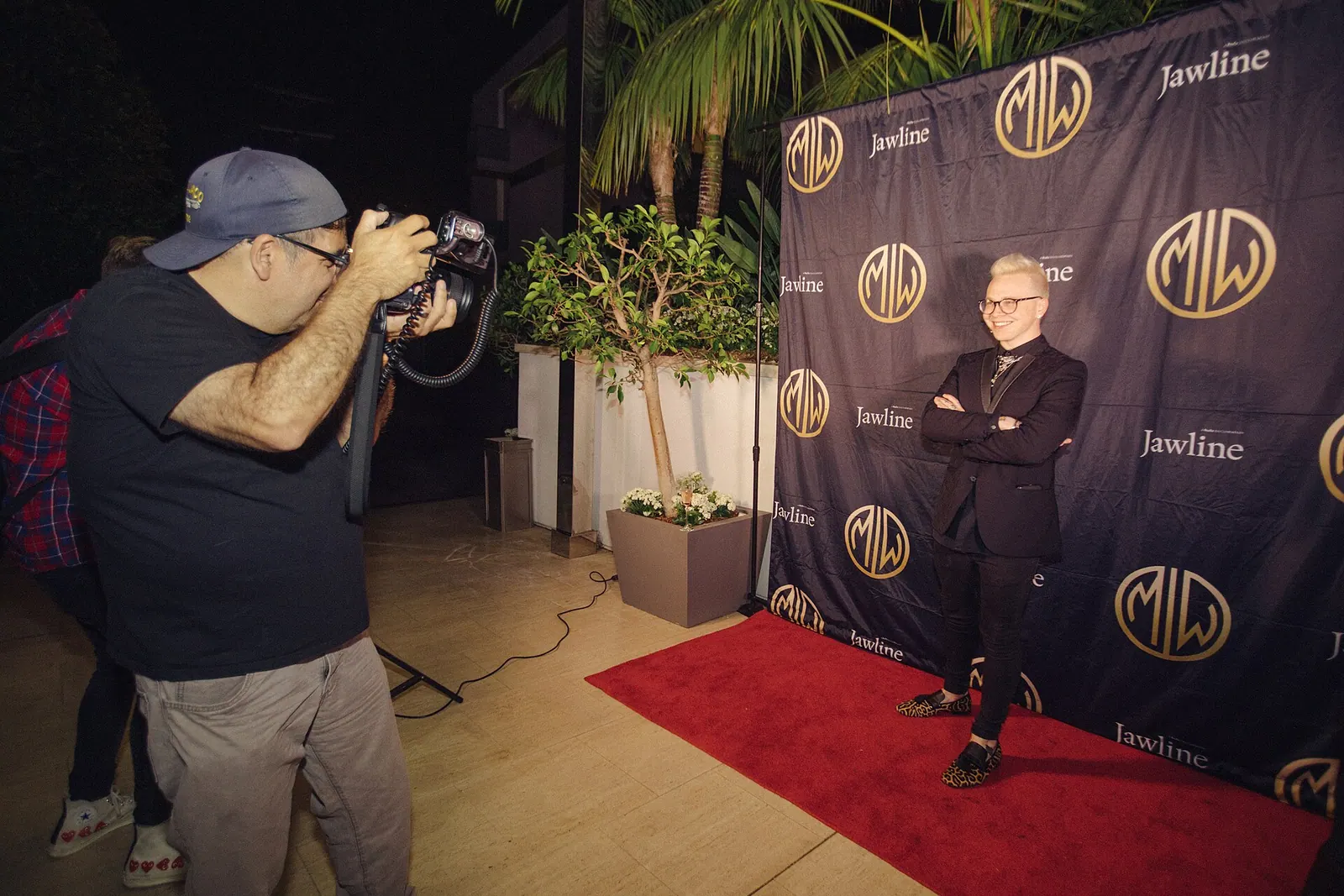
Red-carpet photography is mostly flash at close range, which flattens fabric and exaggerates every gap. Four points matter more than anything else.
- Collar gap. The jacket collar should sit against the shirt collar with no visible space at the back of the neck. This shows in any three-quarter shot.
- Sleeve pitch. The sleeve should hang without twisting. Twisting reads as a spiral crease down the arm.
- Trouser break. One soft fold at the shoe, no pooling. A pool of cloth shortens the leg in a full-length frame.
- Waist suppression. The jacket should close without a horizontal pull at the button. A pulling button creates a crease that flash photography turns into a dark band.
The Wikipedia article on tuxedo covers the component list, including the satin facing and the covered buttons that define the garment. The Wikipedia article on black tie explains the fit expectations attached to each piece.
A jacket that fits in the fitting room can still fail under flash. Ask the tailor to photograph you in the finished garment with a phone flash before you accept it.
What New York and Los Angeles change
New York tailors work on tighter calendars, and rush charges are common in the weeks before a gala. Los Angeles has more houses that cut for a leaner silhouette, which suits some builds and fights others.
Sales tax differs by state and city, so the same tuxedo can land at different totals in the two markets. If you are weighing a smaller label against a national brand, the reasoning in why a best celebrity color season brand does not exist applies to tailoring too: the room decides, not the label.
Example: two men, two budgets
Consider two guests at the same New York gala. The first attends one black-tie event a year. He buys a $700 off-the-rack tuxedo and spends $300 on alterations, for roughly $1,000 before tax.
The second attends four events a year and travels for two of them. He orders made-to-measure at $2,400, with two fittings and a four-week lead time. Over three years that is about $800 an event, and the jacket fits his shoulders from the start.
Neither choice is wrong. The first man should spend his money on the tailor and the shirt. The second should spend it on the pattern. If you are also dressing for daytime events around the same trip, the daylight rules in street style on an ordinary budget are a separate problem.
Where the money leaks
Alterations are the hidden line item. A cheap tuxedo with poor shoulders can absorb $400 in tailoring and still pull at the button.
Fabric is the second leak. A wool tuxedo holds a press through a long evening. A polyester blend shines under flash after an hour, and no tailor fixes that.
Shoes are the third. Patent leather oxfords are the standard, and the Wikipedia article on footwear gives the general construction context. A worn sole shows in seated photographs.
- Confirm the jacket closes with no horizontal pull at the button.
- Check the collar sits flush at the back of the neck.
- Verify one soft break at the trouser hem, no pooling.
- Ask for the finished garment photographed under flash.
- Confirm the return or remake policy in writing before you pay.
Building the rest of the look
The tuxedo is one decision among several. Shirt studs, a self-tied bow tie, and a plain silk pocket square are the baseline. A stylist can source these faster than you can, and what designers and stylists actually do explains how that brief usually runs.
If the event is a fundraiser with a press wall, the jacket will be photographed from the side as well as the front. Side seams matter, and a tailor should check them standing, not seated.
Common questions
How much should I budget for a first tuxedo?
For one event, plan on $700 to $1,100 total, including alterations and a shirt. That figure is illustrative and varies by city and fabric.
How long does made-to-measure take?
Four to ten weeks is typical, with two to three fittings. Rush service exists but usually adds a fee.
Can a tailor fix shoulders that are too narrow?
No. Shoulder width is set by the pattern, which is the main reason to move to made-to-measure.
Do I need bespoke for a red carpet?
Rarely. Made-to-measure covers the fit points that show under flash, and bespoke mainly buys a hand-drafted pattern and more fittings.