Costs
Part of Style by decade: what the experienced already know
Style by decade reviews sorted by what they got right
Style by decade reviews of named vintage sellers, decade by decade, with what each era got right and how to check a clothing listing before you pay.
A style by decade review is only useful if it names the decade, names who sells it well, and says what that era got right. Anything else is a buying guide wearing a review's title.
What to take away
- Each decade solved one problem wellthe 1920s cut, the 1940s utility, the 1950s waist, the 1960s volume, the 1970s drape.
- Buy the decade whose strength matches the problem you have, not the one whose look you like in a photograph.
- A seller who photographs the closure, the hem edge and both underarms is worth paying more to.
- Returns terms decide what a bad buy costs. Read them before the price.
- A claimed decade is a hypothesis. Test it against construction, not styling.
The 1920s: the cut
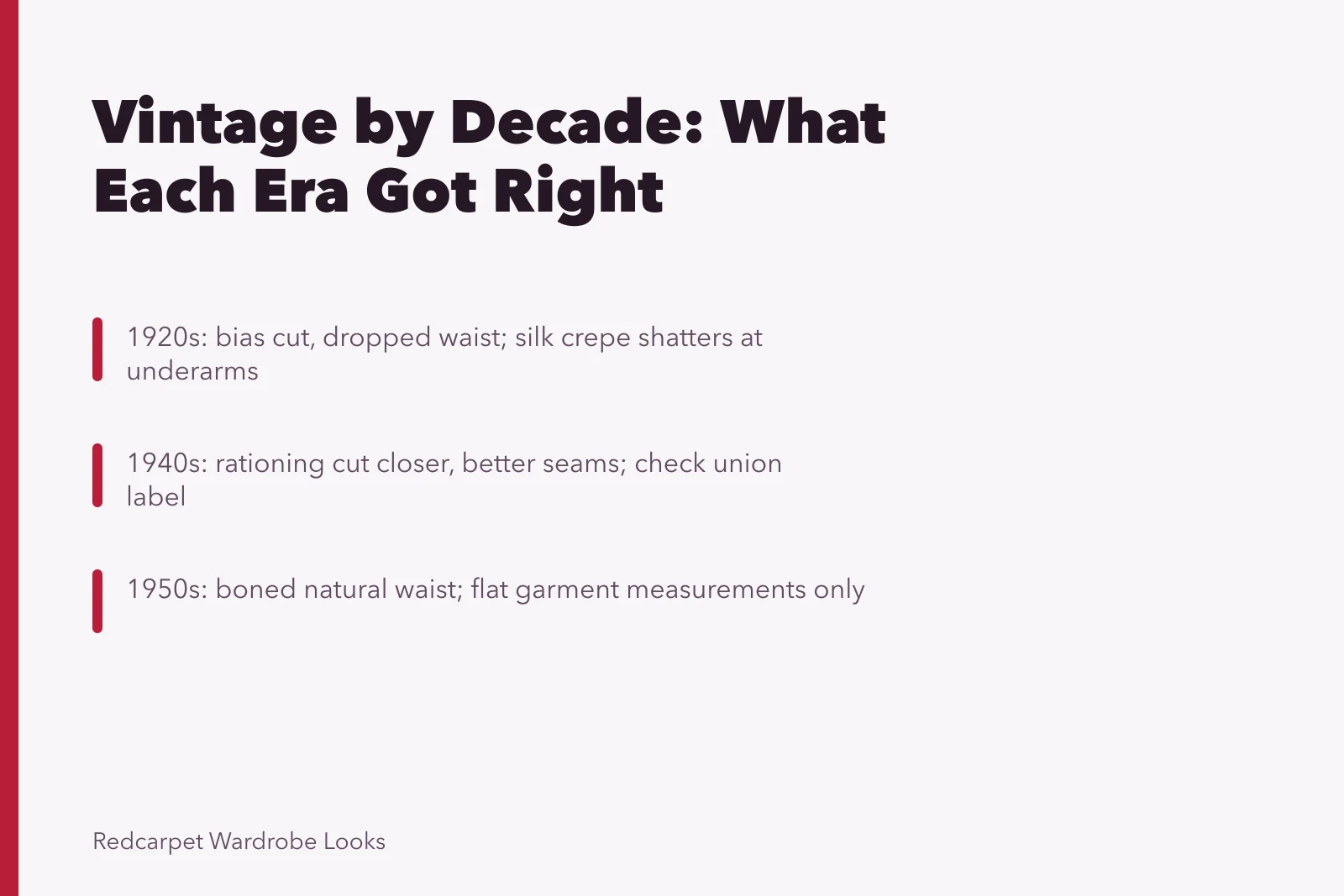
The 1920s got the straight, dropped-waist dress right. Bias cutting, beading and silk crepe made a garment that moves without a fitted waist, and nobody has improved the geometry since.
Condition is the problem. Silk crepe from that era shatters at the shoulder and underarm, and beading sheds. Ask for close photographs of both underarms and the shoulder seams before anything else.
- The Way We WoreLos Angeles, by appointment, museum-grade 1920s and 1930s.
- Cora GinsburgNew York, dealer to museums, price on request.
- Thrifted.comand Vinted: the low end, where you are buying fabric and a pattern rather than a garment.
The 1940s: utility
The 1940s got construction right under constraint. Rationing rules in the United States and Britain limited fabric, so makers cut closer and finished seams better. A 1940s wool suit has more usable structure per yard than almost anything made since.
This is the decade to buy if you want a garment that survives alteration. Look for the union label, which dates the piece and tells you where it was made. Working 1940s wool suits typically sell for $80 to $400 on Etsy and eBay, with rare labels higher.
- Etsysellers who photograph the union label.
- eBaynamed makers, searchable by label.
- New York Vintagethe top of the market.
The 1950s: the waist
The 1950s got the waist right. Boning, interfacing and a defined seam at the natural waist made day dresses that hold a shape without shapewear.
Sizing is the trap. A 1950s size 12 is not a modern 12, and a garment that has been let out at the waist has usually been let out badly. Flat measurements, stated as garment measurements, are the only numbers that matter. A 1950s day dress with original boning typically sells for $75 to $350.
- The Vintage Twinonline, curated 1950s daywear, flat measurements as standard.
- Mirthonline, the same habit, which is worth more than a photograph of the garment on a model.
The 1960s: volume
The 1960s got volume right. A-line, shift and trapeze cuts let a garment hang from the shoulder instead of gripping the body, which is why so much of it still fits people it was not made for.
The cost is fabric quality. Late-1960s synthetics pill and yellow. Ask for fiber content, or a plain statement that it is unknown. Shifts from that decade typically sell for $40 to $200.
- Shrimpton Coutureonline, 1960s and 1970s designer, with real dating notes in the listing.
- Vintage VixenLos Angeles, same practice.
The 1970s: drape
The 1970s got drape right. Jersey, wrap fronts and wide legs made clothes that read as deliberate without being tight, and the era's best tailoring is genuinely good. Jersey dresses from the decade typically sell for $40 to $250.
The failure mode is a later revival. A 1990s reissue of a 1970s cut looks identical in a photograph and is worth a fraction. Check the label wording and the care label, because the FTC's care labeling rule sets when a garment made for the US market had to carry one; the current scope is the regulator's to state.
- Raggedy Threads and Desert Vintage: both online, they date their 1970s stock and flag reissues.
How to check any of it
A date claim is checkable from photographs a seller can take in two minutes.
- The closure. Which fastening, how it is set into the seam, and whether a zipper is metal or synthetic.
- Seam finishes. How raw edges were dealt with says a lot about the era and the workshop.
- The label, photographed legibly. Wording, typography and any union or country-of-origin marking are datable, and a label can be added to any garment.
- Care instructions. Their presence or absence narrows the range.
- The inside. Whether it is lined, how the lining is attached, how the shoulder is built.
Two of the five agreeing is a reasonable range. All five agreeing is as close to certainty as an undocumented garment gets. Where they conflict, the likely explanation is a later revival, one of the traps listed under reference failures.
The reference material to check against sits in collections rather than retail copy, as where the evidence lives sets out.
The terms are the risk
- The returns window, and whether it starts at delivery or dispatch.
- Who pays return shipping, which on a heavy garment across a border is a real number.
- Whether "as described" disputes are covered, and what evidence they require.
- Customs and duties, often not in the displayed price and not refunded with the item.
- Whether the seller will hold the item while a third party inspects it.
Price the worst case before you buy. If a garment cannot be returned and cannot be inspected, you are paying for something you might not be able to wear.
Reviewing after the fact, usefully
Write what happened rather than a rating. State what was described, what arrived, what the measurements actually were, and how the seller responded. Three specific sentences beat five stars, and they are harder to dispute.
Include good outcomes. A seller who measured accurately and photographed faults deserves to be findable, and that is how this market rewards careful work.
The same standard applies to buying from a description rather than in hand. The module vocabulary breaks that down for retail listings, and the pre-purchase list covers garment inspection overall. For how sellers and stylists are assessed generally, see assessing any practitioner.
Common questions
Can I trust a seller's stated decade?
Treat it as their honest belief. Most sellers are not deliberately misleading; dating is genuinely hard, and revivals catch experienced people out. Test it yourself and buy the garment rather than the date.
Is an auction house safer than a marketplace?
Usually more informative, because condition reports are detailed and written by someone who examined the object. Not necessarily cheaper, and the returns position can be worse, so read the conditions of sale.
What if the garment arrives worse than described?
Photograph it exactly as it arrives, before touching it, and open the case within the window. Evidence taken at the moment of unpacking is what these disputes turn on.
Should I pay for a professional assessment?
For an expensive purchase, yes, and ideally before buying. A textile conservator or an experienced dealer can tell you in minutes what is safe to wear, alter or clean, which is the same order argued under buying old clothes sensibly.