Reviews
A shop-the-look checklist for the listing fields that actually matter
A shop the look checklist for buying a garment you cannot touch: the listing fields to confirm, the measurements to compare, and the terms to read before paying.
Buying online removes every check a shop allows. You cannot feel the cloth, test the closure or sit down in it, so the only evidence is what the listing says and what the seller will answer. This checklist replaces the physical checks with documentary ones, in the order that eliminates bad purchases fastest.
What to take away
- Confirm the fields before the price. Composition, measurements and returns decide whether a purchase can go wrong cheaply.
- Compare the garment's flat measurements to something you already own rather than to your body. It is faster and more accurate.
- Product rows under editorial photographs are affiliate channels, so treat a tile as a lead and the retailer's own page as the source.
Before you click: reading the row
The module under an event photograph earns the publisher a commission when a click becomes a sale. Sort the tiles first.
Which tile to trust
Tile says exact or product code?
real match; verify stock and size
resemblance only; use for vocabulary
| Tile label | Treat it as |
|---|---|
| Shop the exact, or a named product code | A real product match; verify stock and size at the source |
| Get the look, or Similar | A resemblance; useful for vocabulary, not for matching |
| As seen, or Worn by | A caption, not a stock statement |
| Sold out, shop similar | The exact match is gone; the remaining tiles are approximations |
| Sponsored, or Partner | Paid placement; match quality unknown |
Then leave the module and work on the retailer's own page, which is where the checkable fields live. The mechanism behind all of this is set out in the pillar on shopping from a photograph.
On the product page: the fields
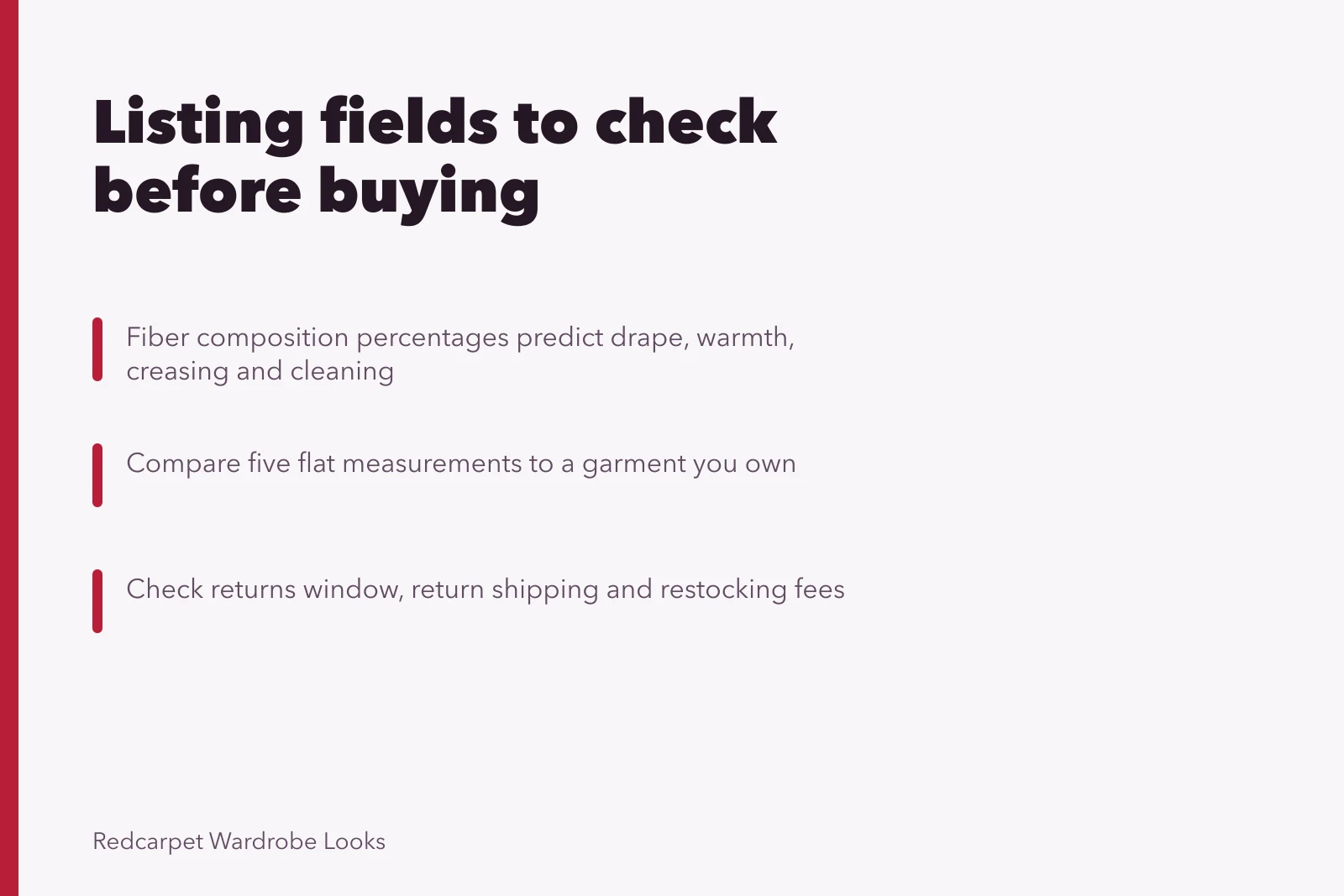
- Fiber composition, as percentages. Each textile fiber behaves differently, so this predicts drape, warmth, creasing and cleaning more than any other field.
- Care instructions. In the United States garments in scope carry them because of the FTC's care labeling rule, and dry-clean-only on a garment you will wear often is a running cost.
- Lining, stated separately. An unlined garment in a light cloth behaves completely differently.
- Flat measurements, ideally for the size you are ordering rather than for the sample size.
- The model's height and the size worn, which is the only way to read a photograph for length.
- Closure type. Front, side, back, or none, and whether you can reach it alone.
- Country of manufacture and seller identity, which tells you whose returns policy applies.
If three of those are missing, ask. A retailer that answers quickly is one you can buy from; a marketplace seller that will not answer is a reason to stop.
Product page fields to confirm
- Fiber composition, as percentages
- Care instructions
- Lining, stated separately
- Flat measurements for your size
- Model's height and size worn
- Closure type
- Country of manufacture and seller
The measurements comparison
- Pick a garment you own that fits the way you want this one to fit.
- Lay it flat and measure across the chest, across the waist, shoulder to shoulder, sleeve length and total length.
- Compare those five numbers to the listing's flat measurements, not to a size chart.
- Allow for the fabric. A woven cloth needs ease; a knit does not, and the same numbers mean different things in each.
- Where a listing gives body measurements rather than garment measurements, ask which they are. It is the commonest source of a bad fit.
This is the same discipline that makes secondhand buying work, described under assessing a listing, and it is what replaces trying something on.
Measure your own garment
- Pick a garment that fits as you want
- Lay flat; measure chest, waist, shoulder, sleeve, length
- Compare five numbers to listing's flat measurements
- Allow for fabricwoven needs ease, knit does not
- Ask if listing gives body or garment measurements
The terms
- The returns window, and when it starts.
- Who pays return shipping, and whether a restocking fee applies.
- Whether the window survives a sale price, an alteration or a personalization.
- Duties and taxes on a cross-border order, which are usually not refunded with the goods.
- What evidence a dispute requires, and how long the platform allows.
Read these before the price. A slightly more expensive garment with free returns is usually the cheaper purchase, because it is the one you can undo.
Terms to read first
- Returns window and when it starts
- Who pays return shipping; restocking fee
- Whether window survives sale, alteration, personalization
- Duties and taxes on cross-border orders
- Evidence a dispute requires, and time allowed
When it arrives
- Photograph it before removing tags, in daylight, including any fault.
- Check it against your five measurements before you put it on.
- Try it with the shoes and the undergarments you will actually wear.
- Sit down in it, raise both arms, and walk toward a mirror rather than standing at one.
- Decide within the window rather than at the end of it, since returns take time to arrive.
Anything that survives all five is a garment worth keeping. Anything that fails on fit goes back the same day. A garment kept for its color and worn once is the most common wasted purchase there is, which the cost of getting color wrong sets out.
For a piece intended for a real event, the physical checks in the in-person list still apply once it is in your hands, and a rehearsal beats any listing, as what goes wrong on the night shows.
Common questions
What if the listing has no measurements at all?
Ask for them. Sellers who handle their stock can measure a garment in a minute. Silence is an answer, and the answer is to buy elsewhere.
Are customer photographs useful?
More useful than studio images, because they are unlit and show the garment on ordinary bodies in ordinary rooms. Read the accompanying height and size notes.
Should I order two sizes?
Where returns are free, yes. It is the closest thing to a fitting room and it costs nothing but the effort of a return.
How do I judge fabric from a screen?
You judge composition and weight instead, and treat the image as unreliable about color and shine. What a surface does to a color across materials is set out under one shade in twelve fabrics.